Utilization and Application of AI (Deep Learning) in Hydrology and Earth Sciences
AI in Hydrology & Earth ScienceAI (Deep Learning) is currently being integrated into various fields with rapid development and evolution. We are actively introducing methods and theories developed in other disciplines into the fields of hydrology and earth sciences. However, many challenges remain to be resolved for these techniques to be effectively applied to real-world phenomena. We are tackling these issues while developing methods specifically tailored for hydrological and earth science applications.
1. Utilization of Deep Learning in Hydrology
Deep learning is advancing rapidly, primarily in the field of information science. We incorporate the latest deep learning methods developed in other fields into hydrology and earth sciences—such as for river discharge, precipitation, groundwater levels, and sea levels—to improve the accuracy of estimation and prediction.
Estimation and Prediction of River Discharge and Groundwater Levels
We apply deep learning methods suitable for time-series data, such as Long Short-Term Memory (LSTM) networks—a type of recurrent neural network—and ensemble learning, to estimate and predict river discharge and groundwater levels, as well as to interpolate missing data. (Yokoo et al., 2021; Sakaguchi et al., 2021; Nagasato et al., 2021; Yokoo, 2021a, 2021b)
Sea Level Estimation
LSTM was utilized for sea level estimation. By including input variables such as the relative positions of the sun and moon from the target location, we enabled estimations that reflect tidal influences. (Ishida et al., 2020)
Precipitation Estimation
We estimate precipitation from atmospheric data using Convolutional Neural Networks (CNN), a deep learning method developed in the field of image processing that is well-suited for handling 2D spatial data. (Nagasato et al., 2020; Nagasato et al., 2021)
Estimation of Hydraulic Conductivity
Using soil test data from across Japan, we estimate hydraulic conductivity—a parameter indicating how easily water flows through the ground—which is essential for understanding groundwater flow and related processes.
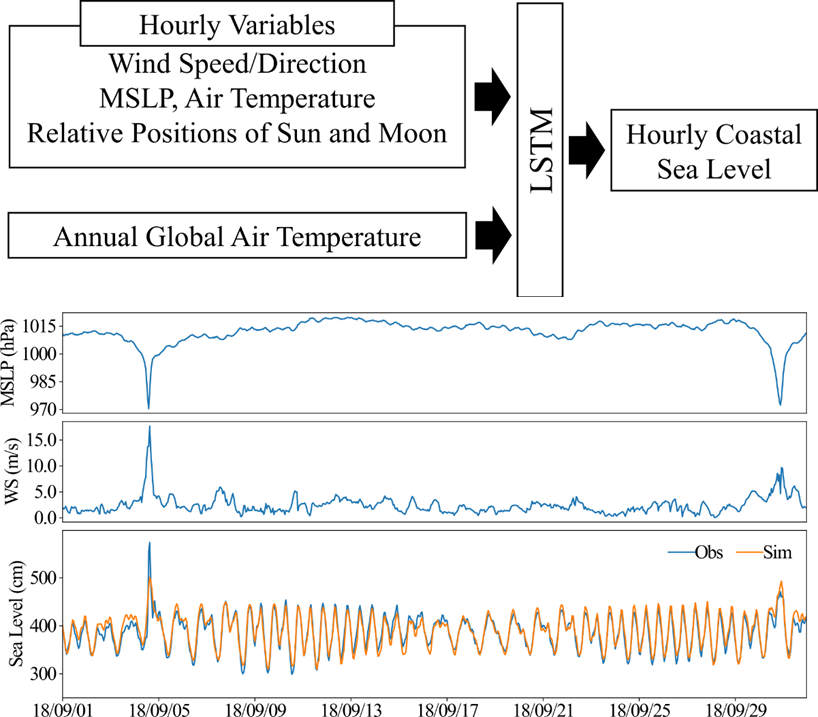
Sea Level Estimation (Ishida et al., 2020)
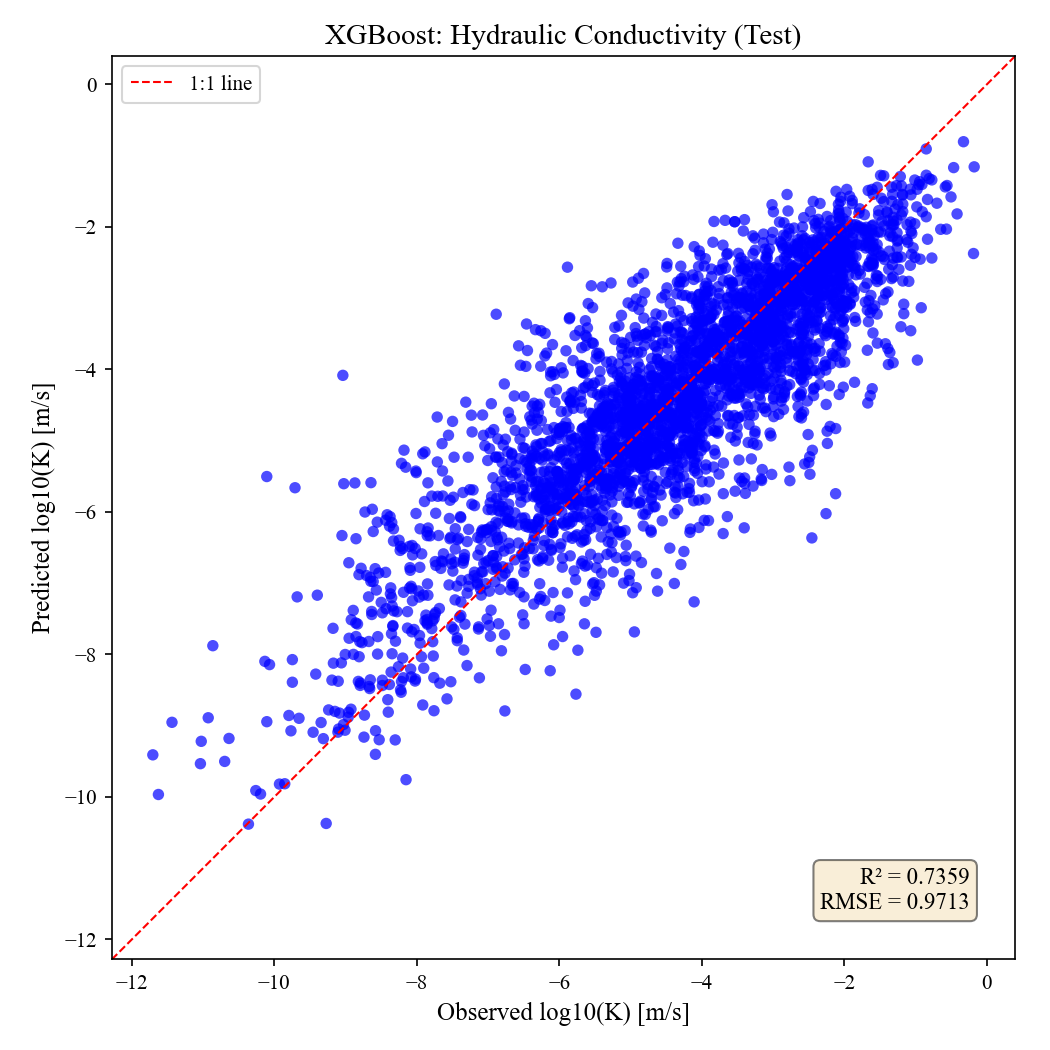
Estimation of Hydraulic Conductivity
2. Investigating Applicability and Limitations of Deep Learning
Deep learning has shown highly accurate results in hydrology and earth sciences. However, deep learning generally learns relationships between datasets rather than following physical laws (though methods incorporating physical laws are being developed). Understanding its applicability and limitations is urgent for its future implementation in society.
Sensitivity Analysis of Input Variables and Physical Meaning
By performing sensitivity analysis of input variables on deep learning models, we investigate which variables improve or degrade prediction accuracy. For instance, when estimating river discharge using various meteorological variables, we examine their impact. Our research found that even meteorological variables physically related to the target variable can sometimes decrease accuracy when used as inputs. (Nagasato et al., 2020)
Limitations of AI (Deep Learning)
Whether deep learning models can learn the underlying physical laws within data is a critical question for their use in hydrology and earth science. We investigated this by providing virtual inputs to deep learning models trained on real-world data. The results indicated that even models with high accuracy can produce results that deviate significantly from physical laws. (Yokoo et al., 2021)
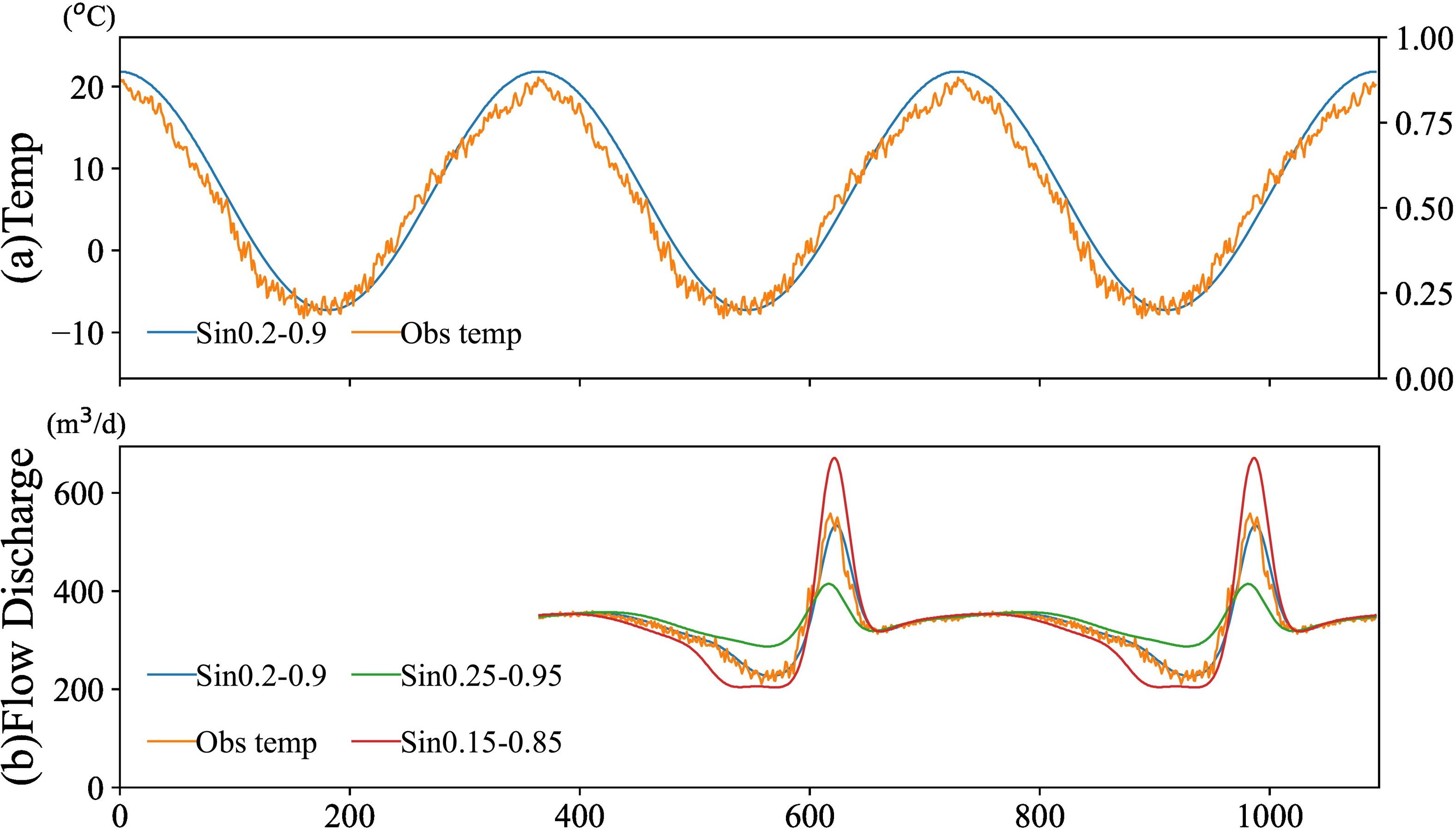
Limitations of Deep Learning (Yokoo et al., 2021)
3. Development of Innovative Architectures and Methods
Beyond just applying existing models, we develop new deep learning methods (architectures) tailored to the specific characteristics of problems in hydrology and earth sciences.
Hourly Rainfall-Runoff Modeling
In basins affected by snowfall and accumulation, hourly rainfall-runoff modeling requires extremely long input sequences. For example, the sequence length for one year of hourly data is 8,760. Standard LSTMs struggle to learn from such long sequences. To address this, we developed methods that combine daily data while intentionally ignoring temporal physical consistency (Ishida et al., 2021), and architectures that combine CNNs and LSTMs (Ishida et al., 2024), achieving both high accuracy and faster training.
Super-Resolution of Sea Surface Temperature
We use deep learning to increase the resolution of sea surface temperature (SST) data. Unlike photos or images in information science, earth science data often contains different physical information between low-resolution and high-resolution versions. Simply applying standard methods from information science does not yield the desired results. Therefore, we are developing new methods and evaluation metrics suitable for the super-resolution of SST. (Izumi et al., 2022)
Hybrid Models with Physical Process Models
We are developing methods that combine regional climate models based on physical processes with deep learning (CNN). This allows for high-resolution precipitation distribution estimation while significantly reducing the computational costs associated with large-scale physical simulations. (Tu et al., 2021)

Architecture combining CNN and LSTM (Ishida et al., 2024)